Probixio
A first-principles AI learning engine that turns a vague workplace learning goal into a diagnosed, practiced, reviewed, and applied skill path.
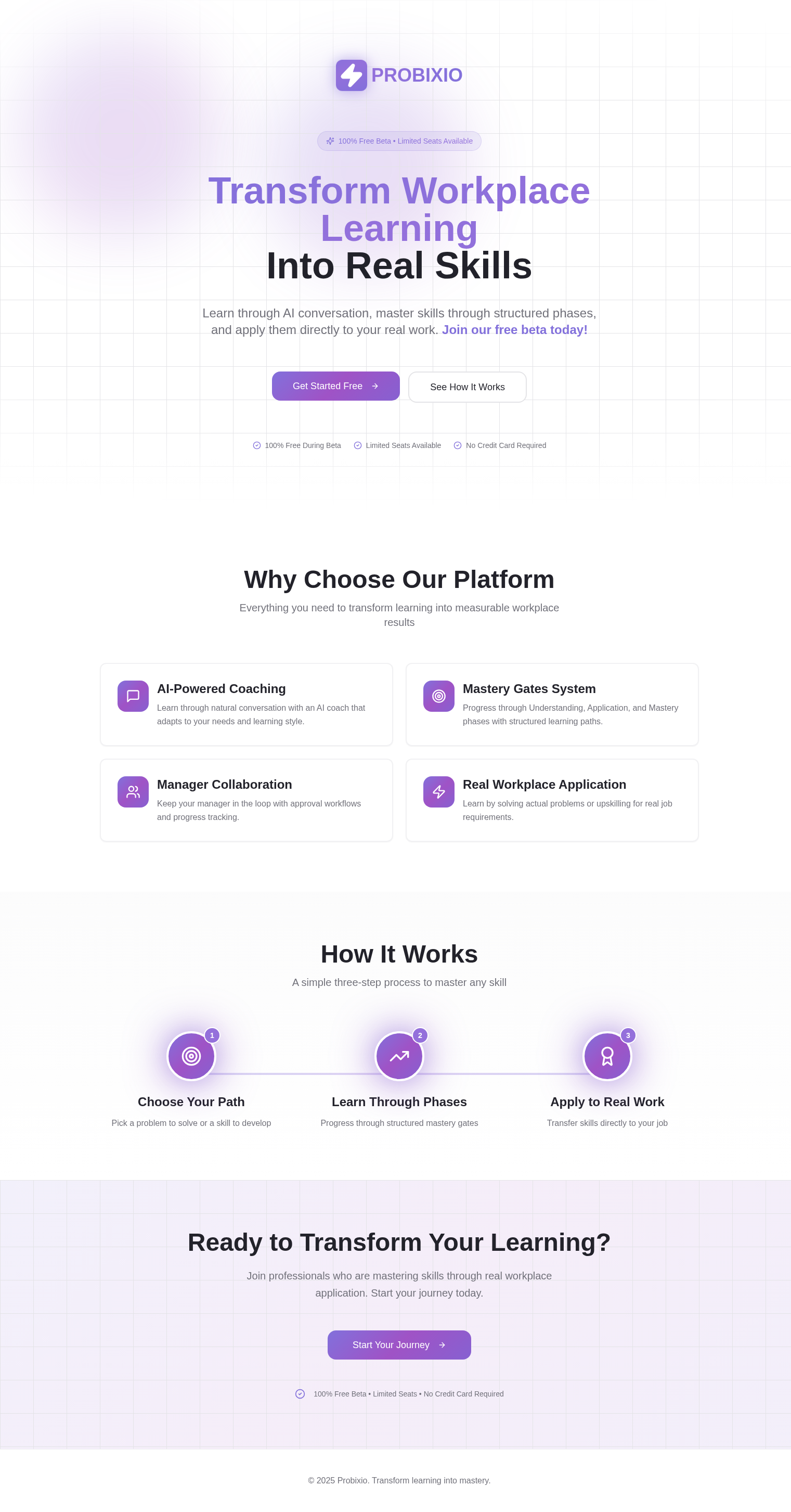
The live product — diagnosis, typed practice templates, and visible mastery state.
Training should end in transfer, not completion
Probixio is built around a simple critique of professional development: most systems can show that a learner consumed content, but not that the learner can use the skill when work gets messy.
The old signal is course completion, certificates, recall quizzes, and passive content paths. The missing layer is prior-knowledge diagnosis, component-level gaps, authentic practice, and feedback and review loops. Probixio’s bet is that if AI learning is structured around diagnosis, practice, project-based application, and spaced review, it can move from “helpful explanation” toward measurable workplace skill transfer.
From thesis to working software
Prototyped in Lovable, then hardened into React/TypeScript/Supabase with typed AI contracts, RLS policies, and edge functions.
Built around diagnosis, practice, application, and spaced review — grounded in learning science, not a ChatGPT wrapper.
Directly applicable to employee onboarding, training, and skill-transfer systems where transfer matters more than completion.
My Role
Sole builder. Designed learning architecture, built MVP with Lovable, hardened into React/TS/Supabase. Wrote typed AI contracts and evaluation logic.
From vague goal to applied skill path
Probixio treats a learning request as the start of a system: diagnose the learner, decompose the domain, teach the missing pieces, test transfer, and schedule review.
Prompt
A learner starts with a vague workplace skill, task, question, or document-driven goal.
Classify
The system classifies intent as exploratory, goal-driven, document-based, or question-driven.
Decompose
The topic becomes 6-10 assessable knowledge components with prerequisite relationships.
Cold take
Probixio asks diagnostic questions before giving content, surfacing evidence, gaps, and misconceptions.
Map
The learner sees the component map and current mastery state before choosing what to study.
Explore
AI-generated modules pick the right template for the learner’s current gaps.
Practice
Retrieval exercises update component mastery and reveal whether knowledge transfers.
Build
Project briefs require the learner to apply multiple components in a realistic task.
Coach
A Socratic coach moves through attempt, reflect, compare, extract, and apply phases.
Review
Spaced retrieval brings components back before they decay.
Graph
Related components across topics become a personal knowledge graph.
How Probixio turns a goal into transferable skill
The product is a pipeline: diagnose the learner, decompose the domain into assessable parts, teach through typed templates, and update mastery through practice.
Diagnosis before content
Multiple-choice and short-answer diagnostics produce component-level evidence instead of a single generic score. The system stores strongest areas, priority gaps, and misconceptions as structured learner context that downstream modules can reference.
Knowledge components
Prompts are classified as exploratory, goal-driven, document-based, or question-driven. The topic is decomposed into 6-10 discrete, assessable components with descriptions, sort order, prerequisites, mastery levels, and points. Lightweight edge detection links related components across topics into a personal knowledge graph.
Structured templates
AI outputs are typed contracts. Explore templates include concept explainers, comparison matrices, process flows, concept maps, connection bridges, and source lists. Practice templates use scenario cards, teaching prompts, reconstruction exercises, compare-and-contrast tasks, and elaboration prompts. Application templates generate project briefs, artifact reviews, Socratic coaching phases, and spaced retrieval reviews.
Mastery and retention
Correct practice increases mastery points and expands the spaced-review interval. Incorrect practice reduces mastery points, resets the interval, and keeps the component active. A Supabase RPC path commits learner response, evaluation, mastery delta, new mastery level, and next review schedule together so progress behaves like a state machine, not a decorative progress bar.
A typed learning system, not a chatbot wrapper
The current app is a React/Vite front end backed by Supabase Auth, Postgres, RLS policies, RPC functions, and edge functions that route AI work through OpenRouter.
- profiles
- topics
- knowledge_components
- cold_takes
- explore_modules
- practice_exercises
- build_artifacts
- coaching_sessions
- spaced_retrieval_schedule
- knowledge_graph_edges
- classify-and-decompose
- evaluate-cold-take
- generate-explore-module
- search-sources
- search-images
- search-videos
- generate-practice-exercises
- evaluate-practice
- generate-project-brief
- review-artifact
- coach-message
Research, venture, and product evidence
One artifact is embedded directly; the rest stay as fast link cards so the page does not become a wall of iframes.
MIT Revolutionary Ventures pitch
Probixio’s venture story: the training transfer gap, target users, and why AI coaching needs structure.
MIT Revolutionary Ventures pitch
The venture framing: workplace training spend, weak transfer, beachhead options, and go-to-market hypothesis.
Open artifactMIT Revolutionary Ventures final deliverable
Written final synthesis for the class, including market logic and product thesis.
Open artifactImpact by Design research deck
The research trail showing how the idea evolved from training engagement into workplace learning transfer.
Open artifactLive app
The public Probixio product surface.
Visit probixio.comMy gateway into vibe-coded products
Probixio was the first project where I used Lovable and vibe coding to move from learning-science theory into a working product surface. That speed mattered: it let me test whether the idea could become software, not just a deck.
- Fast prototype: Lovable made it possible to build a live AI product quickly enough for the idea to keep evolving through use.
- Spec-driven hardening: The codebase later evolved into React, TypeScript, Supabase migrations, RLS policies, typed AI contracts, edge functions, and tests around hooks, stores, schemas, and graph components.
- Design language: The app uses an Obsidian Noir visual system—dark surfaces, glass panels, warm orange accents, and mastery colors as the dominant learning-state signal.